

A business is not automatically off the hook just because rain caused a wet floor. Kentucky law requires property owners to use reasonable care to keep their premises safe, and that duty does not disappear during a storm. If a business knew about a wet or slick surface and failed to address it, or should have known and didn’t check, that business can be held legally responsible for a fall.
September in Louisville often brings the first real wave of fall storms, the kind that roll through fast and leave entryways, parking lots, and grocery store floors soaked for hours afterward. A lot of people assume a rainy day is just bad luck. In many cases, it’s actually a sign that a business cut corners on basic safety.
Why Rain Doesn’t Excuse a Business From Liability
Kentucky courts have made it clear that a hazard being “obvious,” like a wet floor near an entrance during a storm, doesn’t automatically protect a business from a claim. This surprises a lot of people, because the common assumption is that if you can see the water, you should have avoided it, and that’s the end of the story.
That’s not how Kentucky law actually works anymore. In Shelton v. Kentucky Easter Seals Society (2013), the Kentucky Supreme Court ruled that an open and obvious hazard does not eliminate a property owner’s duty to use reasonable care. Two years later, in Carter v. Bullitt Host, LLC (2015), the court reinforced that ruling and applied it directly to a case involving a natural weather hazard: a hotel guest who slipped on ice near the entrance. The court held that whether a hazard was open and obvious is a question for a jury to weigh, not an automatic defense that ends a case before it starts.
For anyone injured on a wet floor during a Kentucky storm, this matters. A business can’t simply argue “the rain was visible” and expect the case to be dismissed. A jury gets to weigh how obvious the hazard actually was, what the business did or didn’t do about it, and how that compares to the injured person’s own actions.
What “Reasonable Care” Actually Requires From a Business
Kentucky law asks whether a property owner exercised ordinary, reasonable care to keep the premises safe. This standard changes with the situation. What counts as reasonable during a light drizzle is different from what’s reasonable during a fast-moving September storm that dumps water through every door for twenty minutes straight.
Reasonable care during wet weather generally includes a few consistent things. Businesses are expected to place mats at entrances before or as soon as rain starts, not hours later. They’re expected to have a system for checking floors regularly during a storm, not just once at opening. They’re expected to put out wet floor signs the moment a hazard is identified, and to actually mop up standing water rather than letting it sit because staff are busy elsewhere.
None of this means a business has to achieve a perfectly dry floor at all times during a downpour. That’s not the standard, and no one expects a completely dry lobby in the middle of a storm. The standard is whether the business responded the way a reasonably careful business would, given what was happening outside.
Notice: The Detail That Decides Most Rainy-Weather Slip and Fall Cases
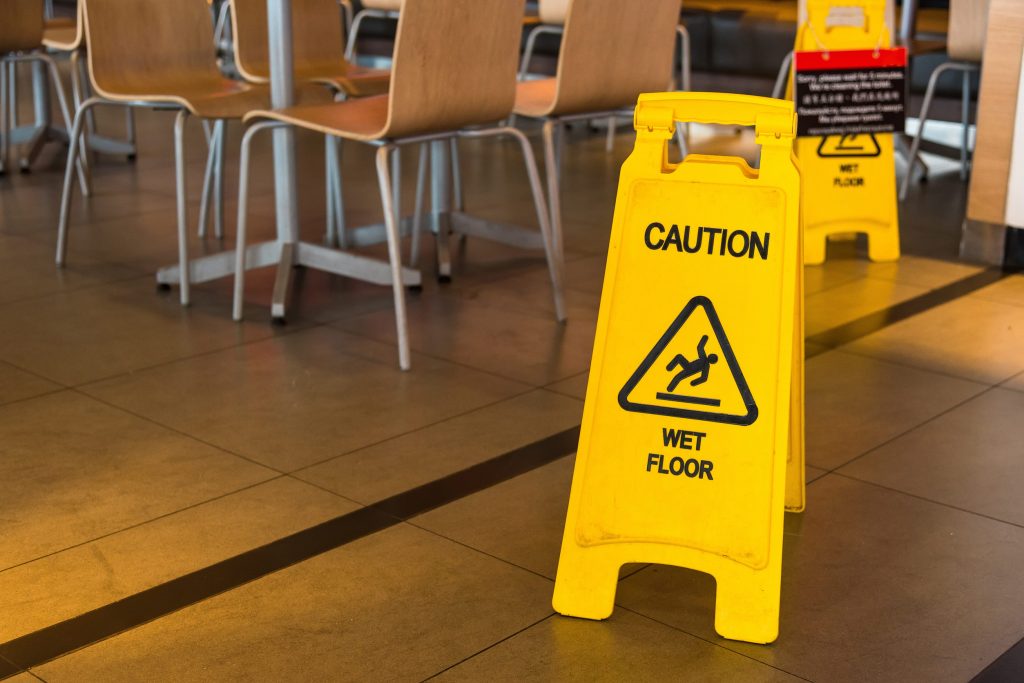
Most rainy-day slip and fall cases in Kentucky come down to one question: did the business know, or should it have known, about the wet condition in time to fix it or warn about it? This is often called notice, and it’s the single biggest factor separating a strong claim from a weak one.
There are two kinds of notice that matter here. Actual notice means an employee saw the water, was told about it, or created it themselves, like tracking it in from a back room. Constructive notice means the hazard existed long enough that a reasonably attentive business should have discovered it through normal inspection, even if no one specifically reported it.
During a storm, constructive notice becomes especially important. If rain has been coming through a door for thirty minutes and no employee checked that area, a strong argument exists that the business should have known. A single puddle that formed sixty seconds before a customer walked through the door is a much harder case to prove, since the business had almost no time to respond.
This is why the exact timing of a fall matters so much. A fall that happens two hours into a storm, when a business had plenty of time to place mats and check floors, looks very different in front of a jury than a fall that happens the moment the first raindrops hit the pavement.
The Insider Detail Most People Miss: Weather Data Can Make or Break Your Case
Here’s something that rarely gets mentioned outside a law office. National Weather Service data, including exact storm start times, rainfall totals, and radar timestamps for a specific Louisville zip code, is public record and can be pulled after the fact. This data becomes powerful evidence in a rainy-weather slip and fall claim.
If a business claims the rain “just started” and they didn’t have time to prepare, weather records can confirm or contradict that. If radar shows steady rain over a specific shopping center for forty-five minutes before a fall, that timeline undercuts a business’s argument that the hazard appeared without warning. On the flip side, if a fall happened within the first few minutes of a sudden downpour, that data can also support the business’s side.
Most people never think to request this information, and by the time they’re building a case months later, they’ve forgotten the exact date and time of the storm. Writing down the date and approximate time of the fall right after it happens, even a rough estimate, makes it possible to pull accurate weather data later. This single detail has changed the outcome of premises liability cases that otherwise came down to one person’s word against another’s.
Common Places Rainy-Weather Falls Happen in Louisville
Certain locations see a disproportionate number of rain-related falls, and knowing why helps explain how liability gets assigned. These situations differ from a typical automobile accident claim because the hazard is stationary and the evidence often depends on maintenance records rather than a police report.
Grocery store and retail entrances. These see the heaviest foot traffic during a storm, since customers track in water continuously for as long as the rain lasts. Stores with automatic doors are especially prone to buildup right at the threshold, where the transition from outdoor pavement to indoor flooring creates a slick strip that’s easy to miss.
Parking lots and garages. Painted lines, sealed pavement, and worn asphalt all become significantly more slick when wet, and poor drainage can leave standing puddles for hours after a storm passes. A parking lot with known drainage problems that a property owner never fixed is a common thread in these cases.
Restaurant and bar entryways. These businesses often have tile or hardwood near the entrance for aesthetic reasons, and that flooring can become dangerously slick within minutes of rain being tracked in in a way that carpet or rubber matting doesn’t.
Covered walkways and awnings. Ironically, covered areas can create a false sense of security. Customers assume a covered walkway is dry, but wind-driven rain or water dripping from the edge of an awning can leave these areas just as wet, and just as unmonitored, as an open entrance.
What to Do If You’re Hurt on a Wet Floor During a Louisville Storm
The steps taken right after a fall shape how strong a claim looks later, especially since floors get mopped and evidence disappears fast.
Report the fall to a manager or employee before leaving, and ask for a written incident report. Most businesses are required to keep these on file, and having one creates a timestamped record that the fall happened and roughly when.
Take photos of the exact spot where you fell, including any standing water, missing mats, or absent wet floor signs. If possible, photograph the surrounding area too, since a wide shot can show whether the hazard was isolated or part of a larger drainage or maintenance problem.
Note the time as precisely as you can. This detail becomes critical later for pulling weather data and establishing how long the hazard likely existed before the fall.
Get contact information from any witnesses, including other customers who may have seen the fall or noticed the wet condition beforehand. Witnesses who saw water sitting there for a while are often the strongest evidence a business had constructive notice.
Seek medical attention even if the injury seems minor at first. Soft tissue injuries and joint damage from a fall don’t always show symptoms immediately, and a same-day medical record connects the injury directly to the incident.
Avoid signing anything or giving a recorded statement to the business’s insurance company before speaking with a personal injury attorney. Insurance adjusters often reach out quickly after a premises liability claim, and early statements can be used to minimize what the business owes later.
Common Mistakes That Weaken a Rainy-Weather Slip and Fall Claim
A handful of avoidable mistakes show up again and again in these cases, and most of them happen in the first hours or days after the fall.
Not reporting the fall at all is the most common. Some people feel embarrassed or assume they’re fine, so they leave without saying anything. Without a report, a business can later claim it has no record the incident ever happened on its property.
Waiting too long to see a doctor is another frequent issue. Kentucky’s statute of limitations for a personal injury claim is generally one year from the date of the incident, but beyond the legal deadline, a long gap between the fall and medical treatment gives an insurance company room to argue the injury came from something else entirely.
Posting about the fall on social media before speaking with anyone about the claim can also cause problems. Insurance companies routinely review public posts, and a casual comment like “I’m fine, just a little sore” can be used to undercut a legitimate injury claim later.
Finally, assuming a business’s liability insurance will simply cover the claim without a fight is a mistake. Commercial property insurers investigate premises liability claims closely, and their goal is to pay as little as possible, not to make sure an injured customer is fairly compensated.
Frequently Asked Questions
Can a business really be held liable if the wet floor was obvious?
Yes. Kentucky courts ruled in Shelton v. Kentucky Easter Seals Society and Carter v. Bullitt Host, LLC that an open and obvious hazard does not automatically eliminate a property owner’s duty of care. A jury weighs how obvious the hazard was alongside what the business did to address it, rather than treating obviousness as an automatic defense.
How long does a business have to clean up a wet floor before it’s liable?
There’s no fixed number of minutes. Liability depends on whether the business had actual or constructive notice of the hazard, meaning either an employee knew about it or the condition existed long enough that reasonable inspection should have caught it. A puddle that sat for thirty minutes during a storm is treated very differently than one that formed seconds before a fall.
What if I was partly at fault for not watching where I was walking?
Kentucky follows a pure comparative fault rule, so partial fault does not block a claim entirely. The percentage of fault assigned to each party adjusts the final compensation rather than eliminating it, meaning a person found twenty percent at fault can still recover damages, just reduced by that percentage.
Do I need a lawyer for a slip and fall claim, or can I handle it with the insurance company directly?
You’re not required to have a lawyer, but commercial insurance companies handle premises liability claims regularly and often offer far less than a claim is worth. An attorney familiar with Kentucky’s notice and comparative fault rules can identify evidence, like weather data or maintenance records, that most people wouldn’t know to request.
How long do I have to file a slip and fall claim in Kentucky?
Kentucky’s statute of limitations for personal injury claims, including slip and fall cases, is generally one year from the date of the incident under KRS 413.140. Missing this deadline typically bars the claim entirely, regardless of how strong the evidence is.
Moving Forward After a Rainy-Weather Fall
Kentucky’s shift away from the open and obvious defense gives injured customers real legal footing after a storm-related fall, but that footing only holds up with solid evidence. Notice, timing, and weather data all play a role in proving a business fell short of the reasonable care it owed, and that evidence starts disappearing the moment the floor gets mopped.
Alex R. White, PLLC, Sue Distracted Driver represents Kentucky residents hurt by negligence on someone else’s property, including slip and fall cases tied to storm and weather conditions across the Louisville area. The team knows how to pull weather records, secure incident reports before they disappear, and build the kind of timeline that separates a strong premises liability claim from a case an insurance company can pick apart. Anyone hurt on a wet floor during a Kentucky storm can get a free case evaluation to understand what their claim may be worth before speaking with any insurance company.
